

Ballad Hunters, News
Ballad Hunters Design Diary: The Child Ballads
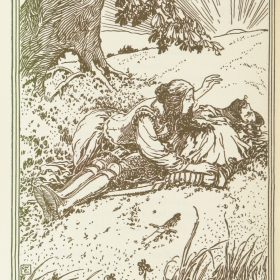 Pelgrane’s forthcoming RPG Ballad Hunters — described in this Page XX article — is about the Child Ballads. They’re named for their compiler, Harvard folklorist Francis James Child. His five-volume collection, published as The English and Scottish Popular Ballads in the late 1800s, is today the standard. Child did not tramp through the British countryside collecting songs. He drew from older manuscripts, to which he added commentary both snobbish and scholarly. Folklorists like the Ballad Hunters investigators are the original source of the 305 Child Ballads and their thousands of documented variants. Applying the name “Child Ballads” to these songs of murder, betrayal, and heartbreak has proven a bit of a misnomer. Enthusiasts often have to caution (or reassure) audiences that the Child Ballads aren’t ballads for children.
As he went over yon high, high hill
And down yon dowie den
Great and grievous was the ghost he saw
Would fear ten thousand men
– Willie’s Fatal Visit, Child Ballad 255
The Child Ballads are stories told in song. The style of storytelling they use focuses on what the characters do and say. The audience must usually infer the characters’ emotions and motivations. The songs are often set in a vague, unspecified past full of knights, lords, and ladies who are endlessly betraying one another, falling in love, committing crimes, encountering the supernatural, and being driven to rash actions by their implied passions.
Some of the Child Ballads are quite old. Child cites Ballad 23, Judas, as coming from a 13th century manuscript. Child Ballad 119, Robin Hood and the Monk, dates to around 1450. But many ballads date back no earlier than the 1800s. Some of the songs the investigators witness coming to life in 1813 might be quite new. Nonetheless, the Child Ballads are mostly of anonymous authorship. They’ve been passed from singer to singer, with each one making their own changes until the ballad no longer has a single author or accepted standard lyrics.
If you’re not familiar with the Child Ballads, you’re in for a treat. I’m particularly fond of this Spotify playlist.
‘The snow so white shall be your shirt
It becomes your body best
The cold bleak wind to be your coat
And the cold wind in your breast’
– The Gardener, Child Ballad 219
I was introduced to the Child Ballads in college. I’d always been a fan of folk music, and when I found out the college had a folk music sing-along club, I was hooked. That club at Carleton College had been meeting since the 1970s and is still meeting today: mostly students, with a few local alums. Two of those alums were Child Ballad scholars, and their enthusiasm for the subject was infectious. I’ve kept doing group singing in the years since. I’m not a great singer, but you don’t have to be. These aren’t choral songs for classically-trained singers, but tales of grief and love and revenge still singable when you’re exhausted after a hard day’s work. The tunes are real forgiving. And that makes it a lot easier for you to get together with your friends and sing a little, which is something I hope Ballad Hunters will let you do. You don’t have to sing the song a Ballad Hunters adventure is about in order to play the adventure. But you’ve gathered with friends (or at least like-minded acquaintances) to play a game about folk music. Why on earth wouldn’t you sing?
If you sing together around the table, you might observe an interesting phenomenon. As a group sings a song they’ve never sung together before, singers tend to match one another, often unconsciously, which means the tune you’re actually singing towards the end is often a little different from the one you were all trying to sing at the beginning. Some individual idiosyncrasies get picked up by other singers, while other idiosyncrasies fall out. That means your group’s rendition of any ballad is unique, not quite like any other iteration that’s ever been sung.
Only sing five to eight verses from any ballad. The Child Ballads can be long, and singing sixteen verses gets old. You can use the first five to eight verses, or you can pick your favorite section of the song to sing. For the verses you don’t sing, go around the table taking turns reading them aloud.
‘Go dress yourself in black,’ she said
‘And go whistling out the way
And mourn no more for your true love
When she’s laid in the clay’
– Young Johnstone, Child Ballad 88
The Ballad Hunters book includes full lyrics for twenty-five Child Ballads, twelve of them with pre-written adventures. We’re also releasing a standalone songbook with all those songs, plus a bunch more. (Expanding the songbook is going to be the focus of Kickstarter stretch goals.) Ballad Hunters includes advice and logistics for singing with your group at the table and online.
We anticipate Ballad Hunters going to crowdfunding in March 2026. The game’s already playtested and written, and is currently in layout. If you want to make sure you don’t miss it, you can sign up for my mailing list here.