

Hillfolk, News, See Page XX
See P. XX: Ragnarok at the OK Corral
a column about roleplaying
by Robin D. Laws
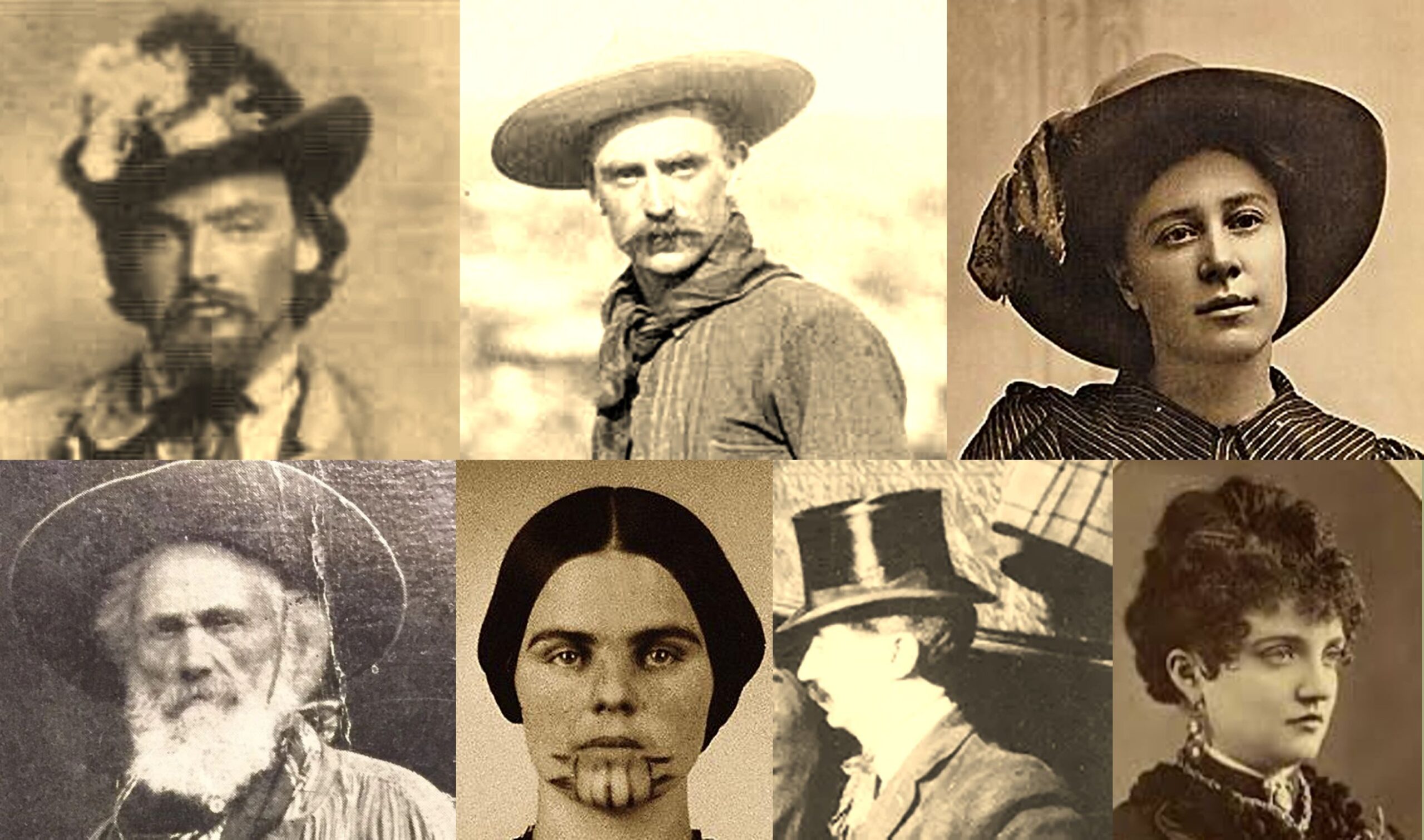
As teased in a previous View from the Pelgrane’s Nest, for the Pelgrane gang’s annual game on Dragonmeet Eve, I ran “Ragnarok at the OK Corral.” While creating this DramaSystem pitch for THE KRAKEN back in the spring of ‘25, I noticed, uh, certain elements that would surely appeal to the team.
Now that their surprises can’t be spoiled, I’m sharing the scenario here. Although I’ve run it so far as a single session game intended to spiral toward transformative doom and a new beginning, you could also turn it into a full series.
In “Ragnarok at the OK Corral,” the players portray various members of the Aesir. Hundreds of years ago, the long-predicted downfall of the gods came for them. The prophesied actions, including those of certain of the PCs, took place. Asgard died.
But they didn’t.
Something suspended their full collective destiny. With the divine realms shattered, they had nowhere to go but Midgard, land of the mortals. There they survived, retaining an unhappy immortality and vestiges of their former powers. History rolled on, with the warlike Norse who once worshiped them becoming Christians, and then the premodern Scandinavians. In ways their players might or might not flesh out in the course of their scenes, the Aesir have knocked around semi-aimlessly since then, drawn to places where humankind shows its restless, violent side.
By 1879 that means the American west. The gods have reinvented themselves to suit the times. Tyr fought as a colonel in the civil war, picking the side he knew would lose. Under the nickname Thunderin’ Kid, Thor won fame as a notorious gunslinger. Frigg runs the cleanest saloon in Tombstone Arizona.
On November 23rd, a date the historically versed will recognize as prior to the arrival of Wyatt Earp, all are drawn to Frigg’s place by messages from Odin, played by the Game Moderator. His long delayed death is about to occur, and he intends to hash everything out with the family before he goes.
The possible player characters are:
The Thunderin’ Kid (Thor)
Queenie LaRue (Frigg)
Maggie Seifried (Sif)
Luke Fortune (Loki)
Squirrelly Joe (Ratatosk)
Colonel Tyrone McLellan (Tyr)
Nona Borden (Nanna)
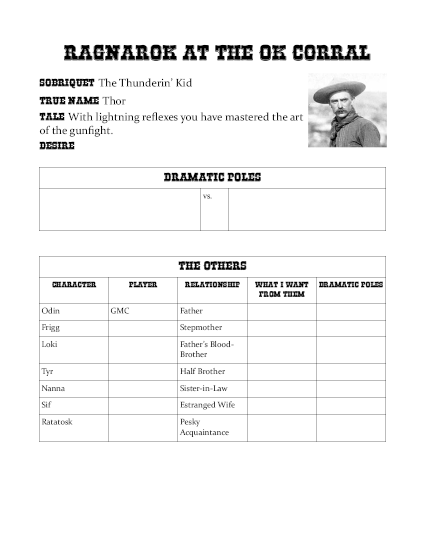
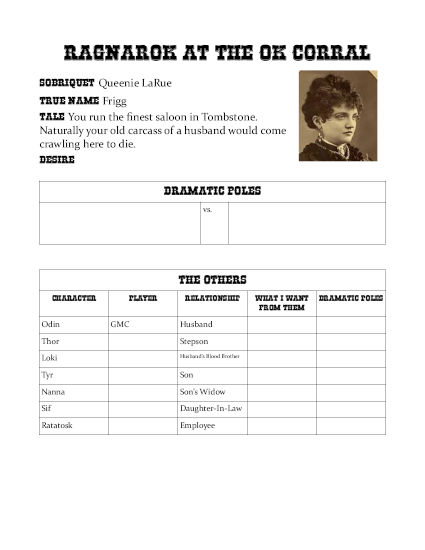
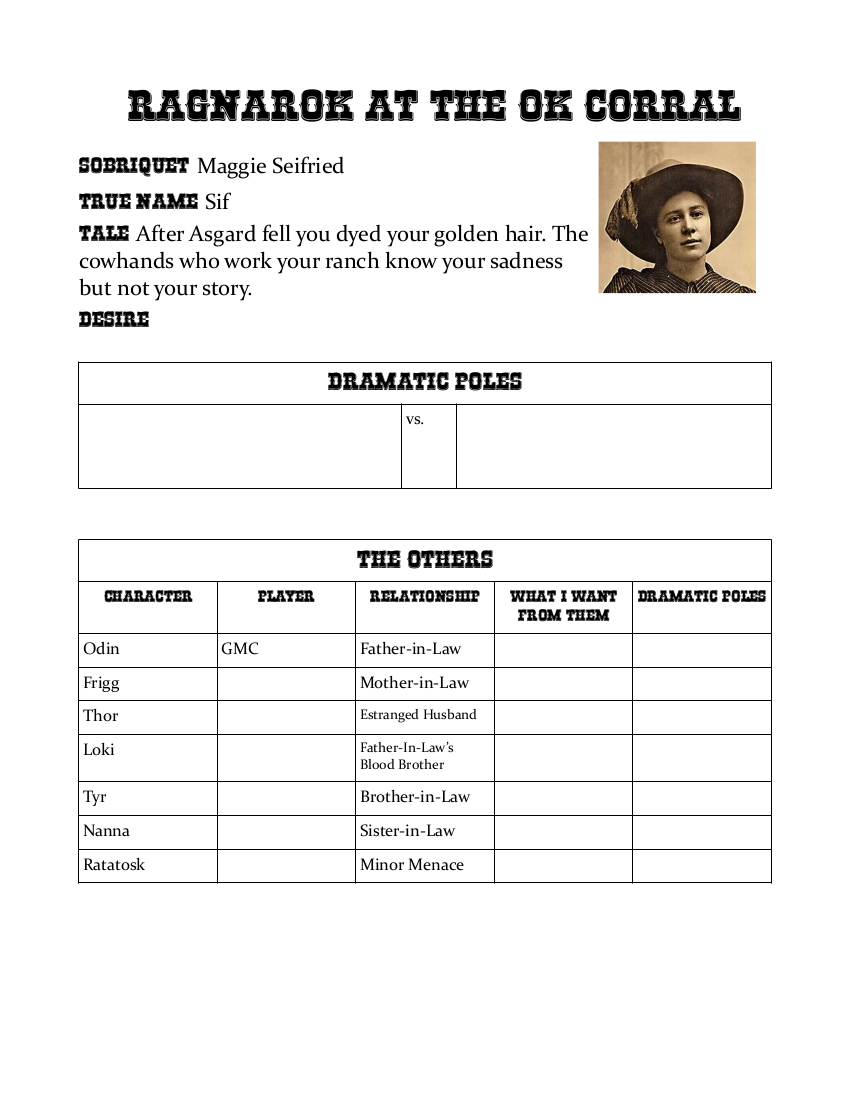
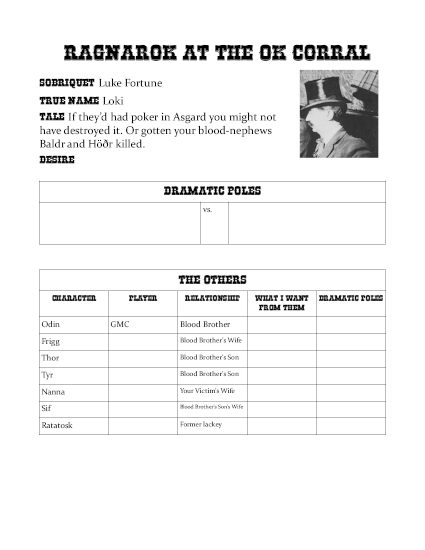
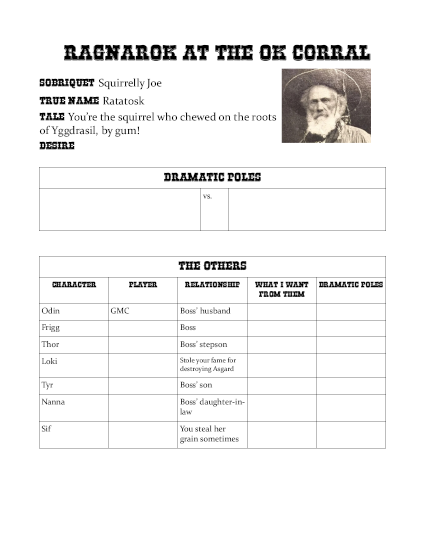
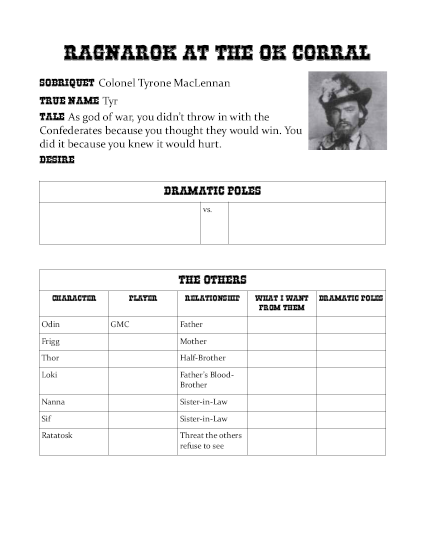
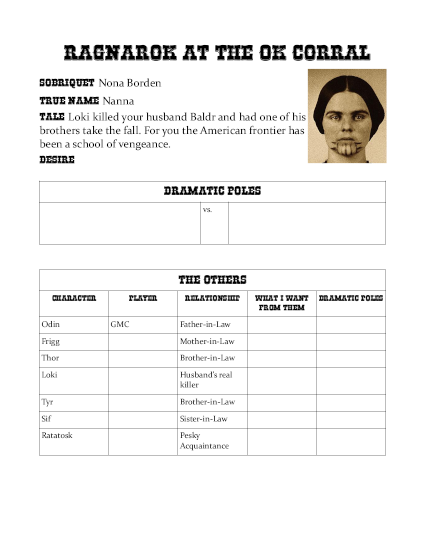
In the GM-called opening scene, Frigg discovers a dust-covered, enervated but still prickly Odin sipping whiskey in a corner of her saloon. The GM plays her estranged husband with the surly arrogance that explains their long estrangement. He reveals that he’s invited the rest of the clan to pay homage to him one last time before he fades away once and for all. Whether Frigg’s player gives him the deference he wants determines who gets the drama token, and where the story heads.
Someone usually picks Queenie, but if not Loki or even the saloon’s handyman, Squirrelly Joe, can spot him and get the story.
That set up, plus these character sheets, are all you need to get the game rolling. Note that the public-facing character sheet for Squirrelly Joe, aka Ratatosk, the squirrel who ate the roots of Yggdrasil, does not, for copyright reasons, feature an image of Walter Brennan. I bet Ken, his player, would have caught on without that visual signal. If you want to pop Walter in the image window of the character sheet, replacing the authentic public domain frontiersman, who’s to know?
Although you won’t likely be running for a player who has turned squirrel aversion into a multiyear trademark running bit, I bet your version of Colonel Tyrone MacLennan will likewise set himself at odds with Squirrelly Joe, as he did for the groups I ran this for at THE KRAKEN.
Running DramaSystem with preassigned characters helps gets a single session started. Even with defined personalities, relationships, and roles, asking players to create Dramatic Poles and their Unmet Needs still offers plenty of leeway for variant portrayals. For example, the four Lokis differed substantially, from classically scheming to philosophical and world-weary. His Dramatic Poles, as chosen by the players, were:
-
Provocation vs Love
-
Fun vs. Power
-
Destruction vs Playfulness
-
Acceptance vs Thrills
All of these fit the theme and the character but shaped play in subtly or markedly different ways.
In our recent session Cat, playing Thor, broke from the previously established pattern by embracing the thunder god’s mythically authentic dumb guy side. She decided that her rootin’, tootin’, pistol-shootin’ gunslinger would always fall for whatever ploy Loki laid out for him. He batted away advice to the contrary from all the other Aesir as if sweeping aside a horde of stone-headed giants. This showed how much fun you can have in DramaSystem by stepping back from pure identification with your character’s goals, instead making decisions you as a player know to be potentially disastrous. Because this game is about emotional consequences, not problem solving, you don’t hose yourself by doing this the way you would in a game like 13th Age or GUMSHOE. Nor do you mess up the other players, who here might even benefit by your enthusiastically sought comeuppance.
THE KRAKEN sessions all ended with a conclusive turning of the cosmic wheel, with some gods destroyed and others newly ascendant. Because we had to get up and run a booth the next morning, we didn’t have time to definitively close out the story. Instead I did what I used to do when running one-shots of the core Hillfolk setting, ending on a cliffhanger and announcing that the players had just completed the first episode of their ongoing prestige cable series. In this case, I withheld the key development that in a four-hour slot shifts the game into high gear. This time Odin died not at the halfway mark, but in the final scene, torn apart by monstrous children of Frigg who had been scheming with Ratatosk. You know, like in the myths.
Your version won’t end that way, because you can never predict what will happen in a DramaSystem session. A possible coda I have never been able to get to the table features the arrival in Tombstone of Wyatt Earp, and with it the idea that the baton of mythic violence has now been passed from the gods to the mortals of the Old West.
Grab the character sheets here and let us know where it went for you. Bonus points for hitting the Earp bit at the end.
Hillfolk is a game of high-stakes interpersonal conflict by acclaimed designer Robin D. Laws. Using its DramaSystem rules, you and your friends can weave enthralling sagas of Iron Age tribes, Regency socialites, border town drug kingpins, a troubled crime family, posthuman cyberpunks and more. Purchase Hillfolk and its companion Blood in the Snow in the Pelgrane Shop.