

News, See Page XX, Yellow King Roleplaying Game
Page XX: Queen of Queens
A Yellow King: Paris Scenario Spine
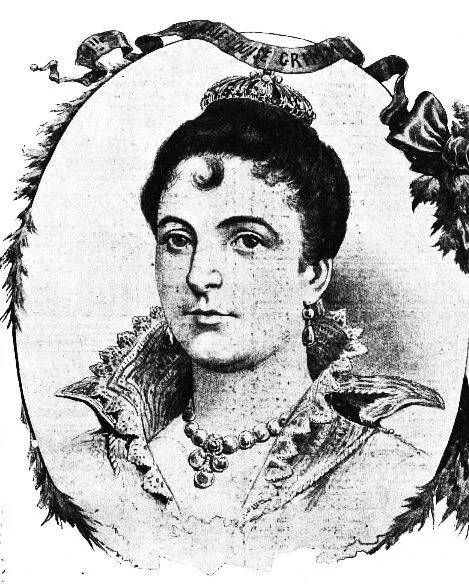
On March 23rd, 1895, the group’s Muse or Belle-Lettrist brings the rest of the art students to the Cafe de la Paix on the Boulevard des Capucines, near the Opera Garnier in the 2nd arrondissement. They arrive during the cafe’s sleepy midday hours to meet a distressed, humbly garbed young woman, Marie-Louise Grimm. The investigator making the introduction knows her through contacts with the washerwoman’s syndicate. This collective of female laborers has been a presence in Paris for decades, gathering the power of workers from over a hundred wash-houses.
Though they didn’t catch her name at the time, the group recognizes the young woman from a couple of nights before. She is Marie-Louise Grimm, recently crowned the city’s queen of queens. At this point you flash back to the group’s attendance at a major event of the Parisian calendar, the Mi-Carême (Mid-Lent) celebration central to the city’s carnival. The art students recall the raucous all-day parade, which follows the election of its one-night-only ceremonial queen.
At any point in the flashback players may make it interactive by specifying what their characters did and said, including the striking up of acquaintances that might become relevant later in the investigation. Framing the part before the investigators have anything active to do as a flashback spares them the feeling of being stuck in a cut scene whose point they don’t yet know. In this structure they see that they’ll be called on to help a particular someone and can look for ways to relevantly insert themselves into the proceedings.
Let them specify which of them showed up at the event’s very beginning, at the Cafe de la Paix, for the election of the queen. They might have been reporting on it for a journal, making sketches for a painting or sculpture, or soaking in the local atmosphere as young Americans here in Paris for bohemian experience.
At the cafe a selection committee of washerwomen, blanchisseuses as they are locally known, select their queen of queens. Over a hundred young women, all members of the syndicate, proceed past the improvised dais, numbers pinned to their blouses. A surprisingly serious air hangs over the process. One art student sees a woman take off a candidate’s overly decorated hat, warning her that the committee scorns such fripperies. The candidates wear sober expressions, indicating their goodness and dignified comportment. At the end young Marie-Louise is chosen, to her surprise and excitement. She designates a strapping young fellow as her king. He is handed the king’s regalia of black cloak and red sash. Marie-Louise receives a gilded circlet crown, a scepter, a diamond ring, and a beautiful gown and cloak.
Her electors and the ladies-in-waiting chosen from the runners-up escort her to a float festooned with flowers. The parade fills the Boulevard des Capucines, with other floats following the queen’s.
Celebrants on foot dress as bears, lions, apes, and clowns. Less committed spectators turn their coats inside out and don false noses. Bands play. Parisians of all classes throng the streets, blocking them entirely. Comedians on floats shout jokes which garner laughs whether they can be heard above the din or not.
Invite the players to describe anything in particular their characters might have gotten up to during the festivities, then cut back to the empty cafe and the present.
The next day, Marie-Louise continues, she returned to her ordinary life of hard work. Only the illustrated portrait of her on the cover of Le Petit Journal marked her giddy hours as queen of queens.
That night is when the horrible affaire particulière began. A weird figure appeared to her in her tiny garret. He didn’t enter; he was just there. Wearing a skull mask and a yellow cloak, he told her that he was a king in need of a queen. He appeared outraged and offended at the sight of her squalid lodgings. The so-called king asked where her gown and crown were. She explained that they belonged to the syndicate and had been taken back, which seemed to greatly affront him. When she said she had a beau, he asked if he was a real king or a counterfeit.
The encounter dizzied Marie-Louise. She awoke later, filled with dread, and worried for her young man, Paul Clarieux. When she couldn’t find him at the barrel maker’s shop where he works, or at his family’s cramped apartment, she asked for help. Her friends contacted the art students, telling her that unexpected people in Paris know how to handle such matters.
Inquiries into the reclaimed royal regalia lead to the syndicate committee member charged with storing them. The group finds Anne Bergue working on a floating washing house, one of many such remarkable waterborne establishments plying the waters of the Seine.
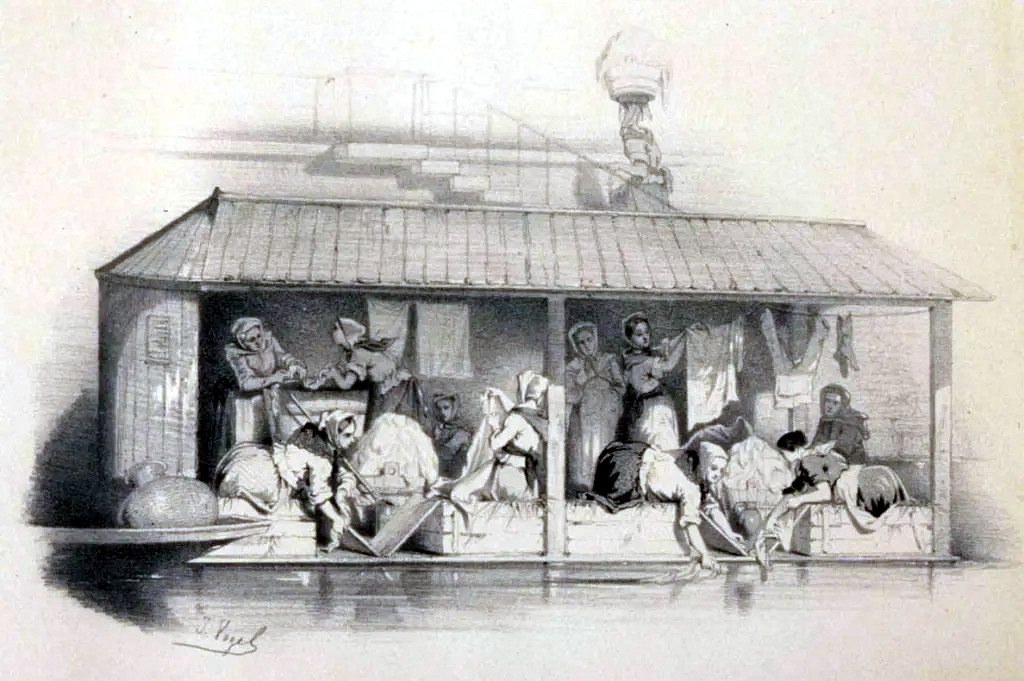
Terrible ghostly claw marks, wounds that somehow never pierced the skin, run down her throat. She attributes them to a terrifying moment of confrontation with the unreal. A skull-masked man in a yellow cloak demanded that she hand over the accoutrements of his queen. When he saw the crown was merely a gilded band of copper, she thought he would kill her. He clawed at her, striking her throat. She fainted dead away. Maybe that’s why the monster was moved to spare her.
The investigators can find the culprit by finding witnesses who saw him stealing proper jewels for his queen, or stalking Paul Clarieux. Look for ways for contacts they made during the parade flashback to point them in the right direction.
Grudges they may have sparked in that sequence result in complicating Antagonist Reactions.
Using their investigative abilities they trace the king’s reported footsteps to an abandoned factory on the city’s outskirts.
Is he the literal, incarnate King, or an avatar, the possessed corpse of flaneur Leon Talazac, said by his friends to have recently read the play? At any rate, the art students must either find a way to physically banish him, or to convince him that Marie-Louise is not his fated queen. If they can, they save both her and his captive, Paul, from Carcosa’s clutches.
One of the investigators might volunteer to become his consort, negotiating for a suitably long engagement. Will it prove long enough to avoid the obligation forever?
The Yellow King Roleplaying Game takes you on a brain-bending spiral through multiple selves and timelines, pitting characters against the reality-altering horror of The King in Yellow. When read, this suppressed play invites madness, and remolds our world into a colony of the alien planet Carcosa. Four core books, served up together in a beautiful slipcase, confront layers with an epic journey into horror in four alternate-reality settings: Belle Epoque Paris, The Wars, Aftermath, and This Is Normal Now. Purchase The Yellow King Roleplaying Game in print and PDF at the Pelgrane Shop.