


Gumshoe, News, See Page XX
See Page XX: Pressing for More Information
a column about roleplaying
by Robin D. Laws
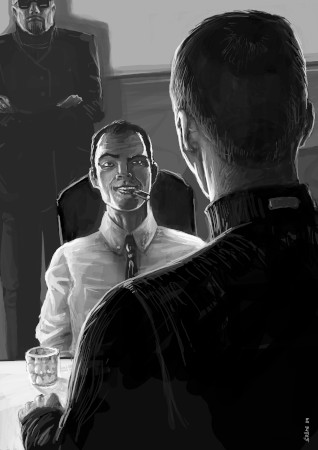 We’ve all seen the stock scene in a detective drama where the investigator breaks down the resistance of a reluctant informant in stages, finally eliciting the nugget of info she’s looking for.
-
The informant starts with a stonewall.
-
The investigator counters this deflection.
-
The informant gives a little, but then shuts down or adopts another deception or digression.
-
The investigator doubles down on the tactic used to initially break through the stonewall.
-
The informant gives it up in full.
In GUMSHOE play, step two corresponds to the use of an Interpersonal ability. This varies, depending on which of these the particular player character has on her sheet, and what the best way to get at this specific informant appears to be. The investigators might use Reassurance on a frightened witness, Intimidation on one who deserves to be rattled, Streetwise to win the trust of an underworld hanger-on, and so forth. In group play the team probably selects the member with the appropriate ability to make the approach.
Early GUMSHOE products sometimes used investigative spends to emulate step four. You get a basic clue automatically and for free, but have to spend a point to get more.
Pretty quickly GMs let us know that players did not like this. Although I initially conceived of spends as providing a boost of fun but inconsequential extra coolness, players felt that they were spending a resource and should get something significant for that. They expected more than information that wasn’t so different from the info they were getting for free.
Having received this feedback we shifted to favoring tangible non-informational benefits for investigative spends: the witness helps you, you get a useful object, you gain a bonus if a particular possible fight breaks out. Some informational benefits still work, providing a clear benefit. Examples include clues that get you to a scene faster or with less of a price to pay. However, the player has to realize that they will do this to feel they’ve received fair value for their spend.
Newer GUMSHOE scenarios emulate the partial admission followed by the full revelation without asking for a spend. They give the notation “If pressed.”
The scenario text might look like this:
Society: Madame Lagrange says that her claustrophobic ex-husband would never wear a mask.
If pressed, she admits that he was seeing a mesmerist, who promised to alleviate his fear of confined clothing, face coverings, or small spaces.
To play this as a GM, treat any pushback from the investigator, including a relevant follow-up question, to count as pressing the witness. The PC doesn’t have to press hard. They just have to press. Most interactions with GUMSHOE informants play out as a back-and-forth so this tends to happen naturally. When it doesn’t, play the character to alert the player to the opportunity to dig further. In the above example, you might play Madame Lagrange as starting out certain, but then waffling, looking flustered, or letting a final statement trail off into a mumble. You can follow up the initial revelation with some waffling to indicate this. When in doubt, look shiftily from side to side.
You may spot an informational spend in a published scenario. We haven’t gone back to errata them all out. A few may have slipped out in new books after our ostensible shift away from them. (With the new power vested in me as Creative Director, expect more ruthless, consistent hand applied to pure info spends from now on.)
When this happens, check to see if the apparent informational spend doesn’t also provide a tangible benefit. Typically such a benefit gets them around an upcoming obstacle. The ability to skip a scene acts as a benefit and is worth a spend, as it lessens the chance of running into an Antagonist Reaction. As the term suggests, these always spell risk or trouble in some way.
When the spend gives an extra advantage, it is written as it is supposed to be. Let it stand.
But when you see no extra benefit to a piece of information connected to a spend, aside from coolness or deeper understanding, change it on the spot from a spend to an “If pressed.” Play the GMC’s reluctance to spill everything at once, making it feel like the characters had to work harder to get everything they need. Just skip the part where you deduct points from an investigative pool.
Writing “if pressed” over and over can become repetitive. In my own scenarios, I try to mix it up, with alternatives such as:
On a follow-up,
If investigators ask for more,
After additional back and forth, [the GMC] breaks down and says,
As a player you can proactively seek more information — and maybe already do. If not, look at your list of Interpersonal abilities and imagine what you might say to further cajole someone who may be fobbing you off with only half of the story.
Assess Honesty: look for half-truths.
Bonhomie / Charm / Flattery: put them at ease with a few jokes or an anecdote, then Columbo your way back to the question when they’ve lowered their guard.
Bureaucracy / Cop Talk / Officialdom: remind them of how busy they are and how much paperwork they’ll avoid if they get this all out of the way in a single tete-a-tete.
Inspiration: reiterate the themes of the stirring speech that won them over.
Intimidation / Interrogation / Steel: narrow your eyes. Crack your knuckles. Loom a little.
Negotiation: pull a few more bills from your wad of dough. (The archetypal example of the two-step resistance breaker.)
Reassurance: flesh out your promise of protection.
Demimonde / Society / Streetwise: build trust with mention of a shared acquaintance.
More importantly than how exactly you ask for more, don’t be shy about making sure that you got everything the informant has to give. If you have to duck back into the doorway and say “One more thing,” well, what better role model could you be following?