

Gumshoe, News, Night's Black Agents, See Page XX, Swords of the Serpentine, Trail of Cthulhu, Yellow King Roleplaying Game
See Page XX: Ain’t That a Hole in the Head
a column about roleplaying
by Robin D. Laws
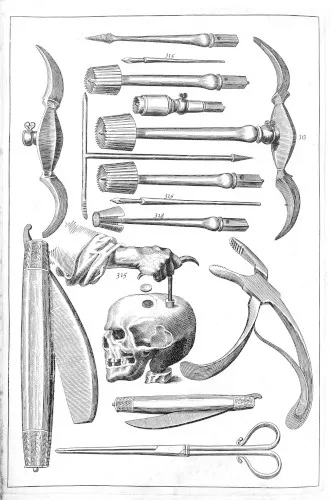
As reported in November, Polish archaeologists recently found a spiked iron tool establishing that druids local to the area, as they did elsewhere, once practiced trepanation. Until around the 19th century, cultures spanning historical and geographical boundaries did what they could to treat apparent brain ailments, by boring through the skull with a drill. Tools used for the procedure ranged from the simple, alarming-looking pointy iron spike with a turning handle found at the Polish iron age site to the better-tooled but still plenty alarming later models shown in the accompanying illustration.
Whatever period their games are set in, players may be reluctant to submit their characters to trepanation. Investigators in the upcoming Georgian England Trail of Cthulhu sourcebook Boundary of the Darkness may be offered a good head boring along with a variety of other treatments we now know to do much more harm than good. These include mercury tonics, the application of caustic chemicals, and of course bleeding, with or without leeches. All of these pale in the horror department to having a hole drilled in one’s cranium. By the 1770s some enlightened physicians have begun to question the process, allowing your bewigged Investigator to beg off on the skull-puncturing in the name of natural science.
The late 19th century French anatomist Paul Broca theorized that rondelles, neolithic skull fragments he first found near Aiguières, were byproducts of trepanning repurposed as magical amulets. Presumably the patients of this prehistoric surgery recovered sufficiently for the bits of removed bone to gain an association with good luck.
This idea raises the prospect of a bone fragment from a trepanation survivor as item of true magical power. Your characters might fight to obtain such an item, or find out who murdered an anthropologist to get their hands on it. Whether it actually works or not matters less than that the killer believes it does. As the culprit might explain, Broca, famed discoverer of the brain’s language center, can’t have been wrong about skull amulets. Perhaps that crime leads the Investigators to a still worse prospect, a cult of modern trepanners intent on harvesting rondelles from the craniums of 1930s notables. Do the heads of the party’s accomplished academics also show up on their wish list?
Unusually advanced trepanation tools found in neolithic sites could be the work of the mi-go, well known for their interest in brain vivisection. The psyches of ancient humans could be preserved as psychoradio waves in the tools. An unscrupulous scientist might attempt to revive these prehistoric consciousnesses, in order to communicate with ancestors from the abyssal past. Naturally this would involve installing their thoughts in the minds of living subjects. Even those rash enough to willingly serve as containment vessels for neolithic personalities could find themselves on the rampage when it all goes predictably wrong. The Investigators follow the path of destruction to put an end to the hideous experiment.
During The Fall of DELTA GREEN era, early LSD experimenter, medical school reject and Amsterdam librarian Bart Huges promoted trepanation as a means to gaining the “third eye” of extrasensory sight. His treatise, The Mechanism of Brainbloodvolume, aka, Homo Sapiens Correctus, appropriately enough appearing in scroll form, posited that by walking upright humans threw their circulatory systems out of whack. The solution? Trepanation! The agents might discover that the true authors of this peculiar theory are inchoate entities seeking either to access the human brain — or to escape it!
Huges claimed inspiration from a friend who had gained the third eye of clairvoyant perception through a head injury suffered in a car accident. A similar shock to the skull in Belle Époque Paris, the Continental War, the alternate post-Castaigne present or our very own entirely normal world could create a miniature, highly localized gateway to Carcosa. This might simply allow Carcosans to override the actions of people with SPT (Spontaneous Pseudo-Trepanation.) It could inspire them to write the text of the play, reviving it even after its successful suppression.
Soldiers in Yellow King: The Wars could attempt trepanation in the trenches in an attempt to escape the horrors of conflict, or to connect with the otherworldly egregores responsible for prolonging the fighting. The squad could stumble upon a cache of weird tech bullets designed not to kill, but to open the third eyes of the enemy. These could be fashioned to promote a pacifistic revolt against an adversary government by soldiers struck by trepanation rounds. Or it might be Camilla or Cassilda up to one of their perverse experiments in aesthetically pleasing sadism.
Burned agents fleeing undead conspiracy in Night’s Black Agents might discover a surprising theory on a USB drive scored from rival agents. According to scans from a moldy Medieval text, the real reason to have oneself trepanned, or burr-holed as it is sometimes called, is to gain immunity from vampiric hypnosis. So that’s what those neolithic brain surgeons and Polish druids were really up to! Can the PCs afford not to take the risk?
In Eversink, drilling a hole in initiates’ heads to grant them sorcerous powers is as efficient a path to Corruption as any. Members of a sorcerous Swords of the Serpentine cabal might be identifiable by the partially healed indentations in the back of the head. They reward or control their lackeys by gifting them rondelle amulets. Amulet wearers gain points of Malus along with an instinctive sense for their masters’ wishes. They lose the ability to question those desires.
The plot to revive ancient sorcerers by implanting their spirits, now resident in their rondelles, fits SotS as well as it would Trail of Cthulhu. Even if neutralized mystically, such amulets might remain highly prized in a decadent society that takes for granted the existence of magic. Rondelle collectors might swindle, betray and even kill in pursuit of bone amulets originating in the skulls of antiquity’s most infamous magicians.
So whether you’re avoiding it in Georgian England, studying it in 1930s America, considering taking it for a spin in a Bucharest safe-house, or exploring its weirder implications in magic-rich Eversink, trepanation offers hours of fun for the GUMSHOE fan of any stripe.
Provided you don’t try it at home.
GUMSHOE is the groundbreaking investigative roleplaying system by Robin D. Laws that shifts the focus of play away from finding clues (or worse, not finding them), and toward interpreting clues, solving mysteries and moving the action forward. GUMSHOE powers many Pelgrane Press games, including The Yellow King Roleplaying Game, Trail of Cthulhu, Night’s Black Agents, Esoterrorists, Ashen Stars, and Mutant City Blues. Learn more about how to run GUMSHOE games, and download the GUMSHOE System Reference Document to make your own GUMSHOE products under the Creative Commons 3.0 Attribution Unported License.