


Swords of the Serpentine
Playtesting: Mantis (Non-Human Heroes) in Swords of the Serpentine
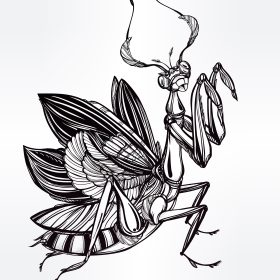
By Kevin Kulp
This is the 14th in our series on non-human heroes in Swords of the Serpentine. Like the High Elves and Forest Elves entries, Mantis aren’t an easy fit into Eversink. This entry on Mantis is only recommended for use if you want to use Swords of the Serpentine to power a high fantasy game, a Dark Sun-style savage game, or the Heroes are traveling away from Eversink.
Be sure to read the previously published rules on Non-Human Heroes if you haven’t already.
Mantis
Ancestry abilities: Ancestry (Mantis), Tactics of Death, Vigilance, Wilderness Mastery
- Ancestry (Mantis) represents your cultural birthright as a man-sized sentient insect, and it gives you access to special mantis abilities. No ranks means that you don’t understand mantis society or social cues; other mantises will consider you “alive-but-dead” and will likely attempt to devour you. A high rank means that you are instinctively treated with wary fear or great respect by other mantises, even those from other hives.
- Tactics of Death models your expertise with your own body’s natural weapons, along with your instinctive ability to efficiently stalk prey.
- Vigilance indicates the acuteness of your senses, not all of which fall within human norms.
- Wilderness Mastery reflects your natural ability to take advantage of wild surroundings, including camouflage and communicating at a base level with other insects.
Make no mistake: you and your hatchmates are predators.
But that doesn’t mean that you are only predators. Each mantis egg sac produces dozens of young the size of a dog, and perhaps a fifth of those survive and grow into human-sized (or larger) adulthood. Some mantises remain emotionless ambush predators who hunt solely out of instinct; others moult into legendarily wise soothsayers who see the workings of small gods around them and who become unexpected repositories of wisdom. Most mantises grow into hunters optimized for stalking prey. Humans often fear you because they never know which sort of mantis you’ll turn out to be.
Your people have their own name for their hive identity, usually two hyphenated three-letter words with few or no vowels. Examples include Kch-Chk, Srt-Tck, or Krn-Thr.
Your mind is not a human mind, and your motivations may vary from those of humans. You constantly consider wind speed, attack vectors, vibration, and the likely taste of prey. You memorize the smells and colors of the wilderness. You may misunderstand subtle human emotions and schemes, especially early on, but you are a fast learner.
You have four legs and two arms. You likely have pincers and a spiky exoskeleton. Decide whether your carapace acts as Armor 0, 1, 2, or 3, with the penalties that entails (SotS p. 136); just be aware that you will be unable to remove this Armor until you moult between adventures. Describe your natural weaponry however you wish, with a damage modifier of +1 (equivalent to a longsword) or +2 (equivalent to a greatsword). You may use human-made weapons, although other mantises would consider that unusual.
You can communicate with others as easily as someone who speaks normally, and it’s up to you why this is. Perhaps you can duplicate human speech by vibrating your shell or buzzing; perhaps you speak telepathically; or perhaps everyone understands the pheromones you emit. Whichever you choose, a communication gap isn’t intended to be a balancing factor for this ancestry, so only add one if it’s fun for everyone at the table.
You are often hungry, although this only becomes distracting when you don’t pay for a Moderate or higher Lifestyle. Eating sentients is as much a crime for mantises in a human city as it would be for humans, however, and would instantly create Grudges or Enemies with anyone who learned of it. Humans are bad at telling one mantis from another, but that’s cold comfort when the guard is after you and you’re one of the only mantises in the entire human city.
Play a mantis if you want to play a socially complex insect-person whose appearance and customs contrast with human culture – or if you want to jump really far into battle before biting off an enemy’s head.
Investigative ability: Ancestry (Mantis)
You’re a mantis, a sentient and humanoid insect with an inhumanly complex social structure. You have knowledge of mantis culture, behavior, history, craft, politics, art, tactics, and traps. You can tell the difference between members of different mantis hives, and speak the clicking pheromonal language of the mantis in addition to the local language of humanity.
This Investigative ability points you towards leads and clues that are linked to mantis as a people and society. You will need to rely on other Investigative abilities to gain leads from specific mantis.
Sample spend: Spend a point to establish a useful fact about Mantis culture, as if you instead spent a point of Laws and Traditions. Make another mantis supporting character particularly like, trust, or accept you as one of their own. Do something insect-like such as climb walls for a scene, lift a heavy weight, or spit acid (destroying something small or adding a die of damage to a successful attack). Use a leg as an arm to gain an extra action. Leave a scent trail for a scene that another character with Vigilance could follow. When taking your normal move, leap one extra range category for every point you spend.
Character Creation Advice
- The more ranks of Ancestry (Mantis) you give yourself, the more bug-like and alien you will seem to humans (and the more dangerous you will seem to other mantis).
- By sacrificing your 1 bonus Build point you can play against type and lean towards the “pray” aspect of praying mantises, selecting abilities like Spirit Sight and Prophecy.
- Mantises are renowned for their tactical prowess and movement in combat. Their speed, maneuverability, and ability to leap often terrify human enemies. Give yourself at least 1 rank of Intimidate, 1 rank of Tactics of Death, and 8 ranks of Athletics to embody this commonly observed trait.
- If you want to model being an ambush predator, give yourself 8 ranks of Stealth and a high Warfare.
- Mantises aren’t known for their Sway ability, but that shouldn’t stop you from creating a charismatically persuasive character if that seems like the most fun; especially if you want to use music to influence others, and you create that music by scraping your leg against your own carapace.
- Mantis sorcerers might choose spheres such as Insects and Plants to control a battlefield. Mantis alchemists might create potions or sorcerous effects by distilling magical fluids within their own body and then secreting that liquid into a small crystalline or chitinous container that they then throw.
- In Eversink, mantis are most likely to come from the Great Flatlands west of the city where they regularly bedevil the Vontavni horse lords. In other settings they are most likely to live in deserts and prairies, although rumors of jungle mantis persist.
Sample Hero – Mantis
Zch-Ssk
Alert, Distrusting, Alien, Hungry, Subservient
Drives (what is best in life?): Satisfying an insatiable curiosity; fighting under the command of a leader you respect; the battle-scent that precedes juice-shedding
Defenses – Health: Health Threshold 4 or higher (shield), Armor 2 (chitin), Health 11
Defenses – Morale: Morale Threshold 3, Grit 1 (detached), Morale 7
Offense – Sway: Sway 1: Damage Modifier +1 (terrifying)
Offense – Warfare: Warfare 8: Damage Modifier +2 (mandibles) or +1 (claws)
Investigative abilities: Intimidation 1, Liar’s Tell 1; Ancestry (Mantis) 3, Tactics of Death 3, Vigilance 2, Wilderness Mastery 1
Allegiances: Ally: Mercenaries 1; Ally: Monstrosities 1; Enemy: Church of Denari 1
General abilities: Athletics 8 (Dodge), Bind Wounds 4, Preparedness 1, Stealth 8 (Where’d She Go?), Sway 1, Warfare 8 (Cleave)
Gear: Shimmering greenish-gold chitin (Armor 2) that you ritually polish with acidic spittle; a truly surprising quantity of compound eyes; mandibles that clack together when you are pleased or angry; more limbs than are strictly necessary; an insatiable curiosity; shameful pride in your combat prowess; never enough food
Sample Adversary
Mantis Battlecaller
Persistent, Effective, Merciless
Defense — Health: Health Threshold 4 or higher (chitin shield), Armor 3 (hardened chitin), Health 10 per Hero
Defense — Morale: Morale Threshold 4, Grit 2, Morale 10 per Hero
Offense — Warfare: +2; Damage Modifier +2 (scythe-arms, although a battlecaller is most likely to act defensively until all nearby mantis drones have been defeated)
Abilities: Malus 15
Special Abilities: Extra Action (cost 3), Lightning Speed (cost 3 – per round), Monstrous Ability (cost 3), Summoning (cost 3 per wave – up to 3 waves of mantis drones)
Special: Invoke the Hive (cost 6): For the scene, any mantis drones within Very Long range of the battlecaller are granted the special ability of Hivemind (SotS p. 162). Hiveminded drones are quite dangerous and provide 2 Refresh tokens instead of 1 when slain.
Misc: Alertness Modifier +2, Stealth Modifier +2
Refresh Tokens: 5
Mantis Drone (Mook)
Fearless, Hungry, Tenacious
Defense — Health: Health Threshold 3, Armor 2 (chitin), Health 1
Defense — Morale: Morale Threshold 3, Grit 2, Morale 1
Offense — Warfare: +1; Fixed Damage 4
Abilities: Malus 3
Special Abilities: Lightning Speed (cost 3 – per round), Monstrous Ability (cost 3)
Misc: Alertness Modifier +1, Stealth Modifier +1
Refresh Tokens: 1
Sample Allegiances
Establishing mantis as a unique faction means that the insect folk have gained political power within Eversink. This might be due to their effect on other countries’ trade, or because they have chosen to interact with humanity more directly.
Having the mantis as Allies means that they trust or tolerate you, or that you have helped them in the past. Most mantis hives are likely to let you pass through their lands uneaten. Use your relationship to learn about their homelands, to recruit drones as soldiers, or to take advantage of their insect magic.
Having mantis as Enemies means that entering their territory is effectively asking to be eaten. They’ll go out of their way to destroy you or chase you away from something they want. Mantis aren’t solitary, so they have a tendency to gather very many drones before coming after an enemy in force. Mantis aren’t usually adept at human politics; in the past, clever Heroes who were hunted by mantis have tricked the hive into attacking a different political enemy instead.
Kevin Kulp (@kevinkulp) and Emily Dresner (@multiplexer) are the co-authors of Swords of the Serpentine, out now in hardback and PDF. Kevin previously helped create TimeWatch and Owl Hoot Trail for Pelgrane Press. When he’s not writing games he’s either smoking BBQ, watching dubious shark movies, or helping 24-hour companies with shiftwork, sleep, and alertness.